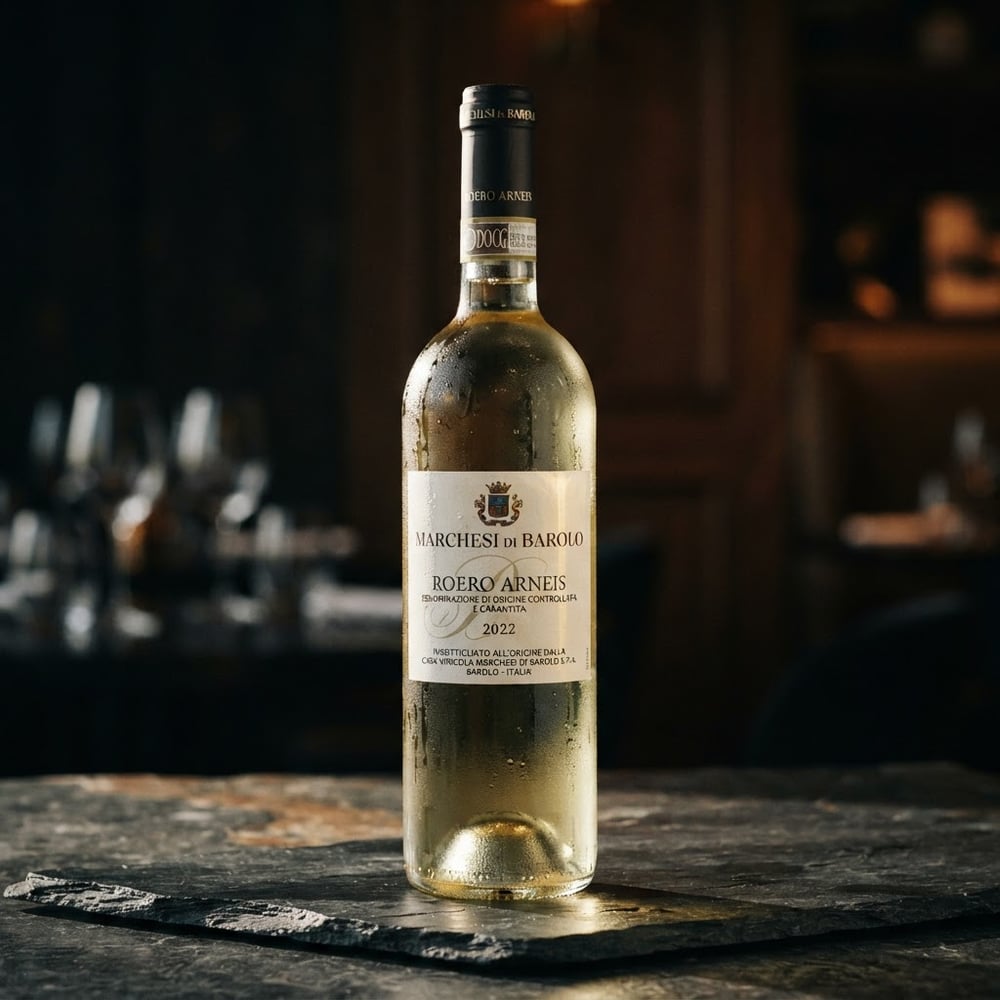
Marchesi di Barolo is best known for the reds of the Langhe, but the estate also works the sandy hills on the left bank of the Tanaro, in Roero, where Arneis has grown for centuries. This is the 2022, from a grape that nearly disappeared in the 1970s and was pulled back from the edge by a handful of growers in the villages around Canale and Montà.
- Arneis, Piedmont's white grape of Roero.
- Roero DOCG, north of Alba, across the Tanaro.
- 2022, a warm vintage in Piedmont.
- 13% ABV, dry, light bodied.
- High acidity, low tannin.
How it is made
Arneis is a thin-skinned, low-yielding variety that was long planted alongside Nebbiolo, partly as a decoy to draw birds away from the red grapes, which is where its name comes from: in Piemontese, arnes means "little rascal". Roero was granted its own DOCG in 2004, and the white is made from Arneis alone. Fermentation is cool and short, and the wine stays on its fine lees for a few months, which is what keeps the mid-palate from going thin.
How it tastes
Pale yellow straw in the glass. Green apple and white peach first, then citrus, then a clear almond note that arrives on the finish and stays. The acidity is high and the body light, so it reads taut rather than soft, with a mineral, faintly saline edge underneath the fruit. The almond is the tell: it is the signature of the grape, and it is why Arneis drinks drier and more savoury than its aromatics suggest.
Where it comes from
Roero sits on the left bank of the Tanaro, north of Alba, separated from Barolo and Barbaresco by the river. The soils here are younger and sandier than the Langhe's, with marine deposits and fossil shells left behind when the sea retreated. That sand is what gives Arneis its perfume and its lighter frame.
Good to know
Arneis was almost gone by the 1970s, down to a few hectares in the Roero hills, and its revival is one of the quieter success stories of Italian wine. The grape is also known as Nebbiolo Bianco in some old registers, though it has no relation to Nebbiolo at all.